

The Two-Year Rule, Tested on 239 Million Jobs
Your seniority predicts how long you'll stay far better than your field does. Experienced hires are most likely to leave in their second year. And staying longer doesn't, on its own, make your next move pay more.
Conventional career advice says you should stay in a job for at least two years, or risk looking like a job hopper. We tested that rule against 239.4 million finished jobs in Swipejobs' US work-history data. Then we asked a harder question: what actually decides how long a job lasts?
The typical job lasted 21.4 months, so the two-year rule sits close to the middle. By "typical," we mean the median: half of jobs ended sooner, and half ended later. The average is higher, at 34 months or more. That's because a small share of jobs, about one in 20, last more than ten years and pull the average up.
That single number hides most of the story.
Your level matters more than your field
Some facts about a job predict its length much better than others do. To compare them, we gave each fact a score. The score shows how well that fact, on its own, predicts the length of a job. The higher the score, the better the predictor.
Seniority explains far more than field, industry or location
Source: Swipejobs work-history data, US, finished jobs only.
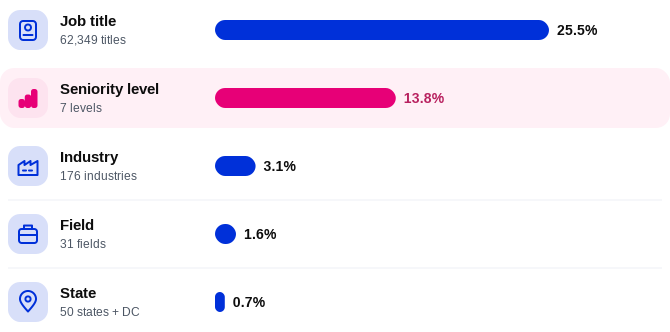
Job title is the best single predictor. Even so, it explains only about a quarter of the variation. The rest comes from things a title can't capture, such as the person, the employer and their life outside work.
Seniority alone explains 13.8%. That's about half as much as job title, even though seniority has just seven levels, from intern to executive. By contrast, your field explains only 1.6%. Whether you work in engineering, finance or marketing makes little difference. Your employer's industry explains 3.1%. In short, your level matters much more than your line of work.
Location matters least, at 0.7%. Bigger job markets do have slightly shorter stays. For every tenfold increase in the number of jobs, stays are about 1.3 months shorter.1 Even so, the effect is small.
Even people with the same job title stay for very different lengths of time. In a typical professional role, a quarter of people leave within a year. Another quarter stay for more than three and a half years. So how long your colleagues stay says little about how long you will.
Year two is the risky one
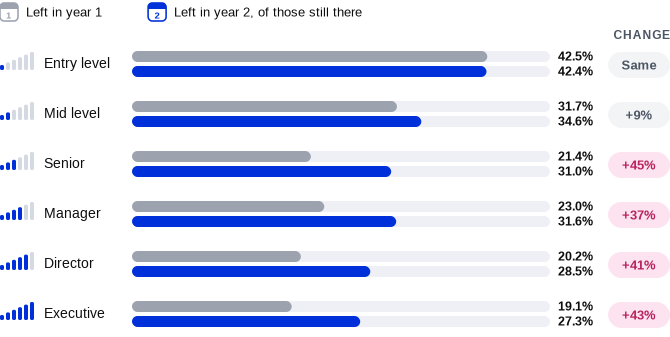
Seniority also shapes when people leave. For each level, we measured two things. First, the share of jobs that ended within a year. Second, among people who were still in the job after a year, the share who left during year two.
Experienced hires are about 40% more likely to leave in year two than in year one
Source: Swipejobs work-history data, US, finished jobs only. Professional fields, excluding internships and trainee roles.
At entry level, the two years look the same. About four in ten jobs end in the first year. Of those still going, about four in ten end in the second.
For experienced hires, the pattern changes. Roughly one in five senior staff, managers, directors and executives leave in their first year. In the second year, that rises to about three in ten. That's an increase of 37% to 45%. One likely explanation: people spend the first year learning the role and proving themselves. Then, in the second year, they decide whether to stay.

Seniority also means longer stays overall. In professional fields, the typical stay rises from 16 months at entry level to 30 months for executives.
A longer stay doesn't buy a better-paid move
Many people stay in a job longer, hoping their next move will be a bigger step up. We tested this on 703,285 job changes in Swipejobs' career-history data. For each change, we compared the typical salary of the old job title with the typical salary of the new one.
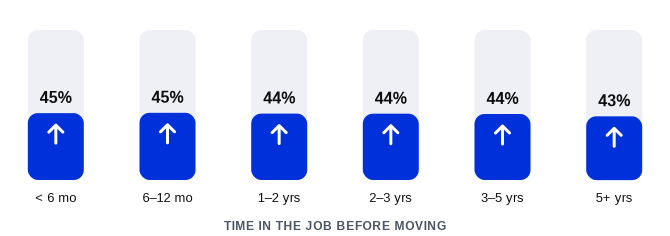
The chance of moving to a better-paid title barely depends on how long you stayed
Source: Swipejobs career-history data, 703,285 job changes by 220,693 people. Pay is the typical salary for each job title, not what each person earned.
Only 44% of job changes were into a better-paying job title. That share barely changed with how long people had stayed. The pattern held early, midway and late in people's careers.
That doesn't mean staying has no value. Our data shows the typical salary for each job title, not what each person earned. So it misses raises and promotions within a job. But a longer stay doesn't, by itself, make your next move a better-paid one.
If you are looking for work
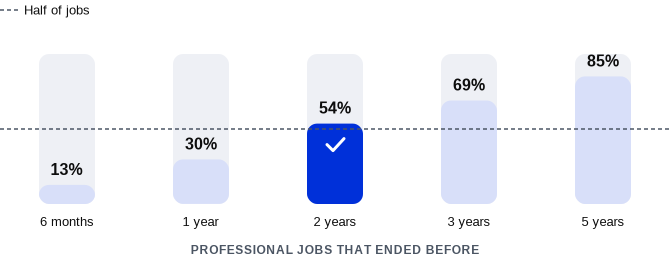
So where does a two-year stay put you? Right in the middle: it's longer than about half of professional jobs.
A two-year stay is longer than about half of professional jobs
Source: Swipejobs work-history data, US, finished jobs only. Professional fields, excluding internships and trainee roles.
- Compare yourself with people at your level. Leaving within a year is common at entry level. At senior levels, it's less common, so be ready to explain why you moved.
- If you're experienced, expect to feel restless in year two. That's when experienced people are most likely to leave. If you go, make it a deliberate decision rather than a reflex.
- Stay for what the job gives you now. Time served won't improve your chances of a better-paid next move. Stay while you're learning, earning raises or working toward a promotion.
- List promotions as separate titles. Two years as an analyst, followed by two as a senior analyst, shows four years of progress rather than two short stays.
And when it's time to move, the next role shouldn't take months to find. Swipejobs matches people with work in real time, so the right job comes to you.
Let the jobs come to you.
If you are hiring
Plan for the second year. Experienced hires are about 40% more likely to leave in their second year than in their first. So start talking with them about growth around the one-year mark.
About the data
- 239.4 million finished jobs in Swipejobs' US work-history data, across all 50 states and DC. Only finished jobs are counted, so real stays are longer.
- Professional jobs: engineering, data, finance, consulting, marketing, law, science, healthcare, education, HR and operations titles, excluding internships and trainee roles.
- Job changes: 703,285 consecutive moves by 220,693 people in Swipejobs' career-history data, priced with the typical salary for each job title.